Showing posts with label News. Show all posts

Feb 2, 2013

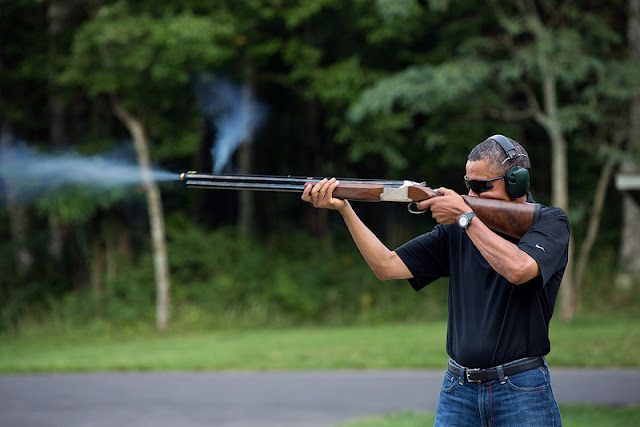
Obama shooting a Browning Citori Shotgun

President Barack Obama shoots clay targets on the range at Camp David, Md., Saturday, Aug. 4, 2012. 
(Official White House Photo)

President Obama stated last week that he picked up shooting clay pigeons as a new hobby during stays at Camp David.  As a result of his comments, this photo was released by the White House as many in the press remained skeptical after President Obama stated that he did it all the time.

In this photo, President Obama is discharging a shotgun and is wearing proper eye and hearing protection.  He's sighting the shotgun properly and has decent form, so we can assume that he's had lessons or has been practicing.

On an email to the Washington Times, Travis Hall (CEO of Browning) identified the shotgun as a Browning Citori.  He described it as possibly a Citori 625 Sporting Golden Clays, adjustable comb, left hand, in 12 gauge retailing for $4,799.


Feb 7, 2012

Exclusive “Statue of Liberty” GLOCK Auctioned Off

(GLOCK Press Release)
Official 2012 SHOT Show Auction Handgun Sells for More Than $15,000
Smyrna, GA (February 2, 2012) - GLOCK, Inc. has announced its highest bidder for the “GLOCK Statue of Liberty Gun,” the one-of-a-kind, hand-engraved GLOCK 22, which served as the official Handgun for the 2012 SHOT Show Auction.  The gun sold to Alexander Wilson for $15,025, which will benefit programs to further America’s hunting and shooting sports heritage.
The exclusive GLOCK features an intricate, hand-engraved tribute to the United States and the Statue of Liberty. This theme was selected to recognize GLOCK’s 25th Anniversary in the United States, which coincides with the 125th Anniversary of the Statue of Liberty.
“In celebration of GLOCK’s 25 years in the United States, Mr. GLOCK wanted to recognize the customers who have helped the company achieve such a milestone,” stated GLOCK Vice President Gary Fletcher. “This one-of-a-kind piece demonstrates GLOCK’s dedication to its advocates.”
In addition to ownership of the exclusive GLOCK pistol, Alexander Wilson, winner of the 2012 SHOT Show handgun, will also receive a signed drawing of the original GLOCK pistol.
The GLOCK was up for auction from Dec. 14-Jan.20 on GunBroker.com, the world’s largest internet auction site for sporting firearms and related equipment, official auction site of the National Sport Shooting Foundation (NSSF) and promotional partner of the Hunting Heritage Trust. This year, 50,382 GunBroker users viewed the 2012 Shot Show Handgun on the popular internet auction site.  As in recent years, bidding for the SHOT Show auction items took place exclusively on GunBroker.com.


About GLOCK, Inc.
GLOCK, Inc. is a leading global manufacturer of pistols and accessories. GLOCK's superior engineering has produced a pistol with only 34 parts and a rugged polymer-frame, providing industry-leading reliability shot after shot. GLOCK is renowned for its pistols which are safe, featuring three safeties; simple, offering a low number of components to provide reliability; and fast, with no encumbering parts to slow the speed to fire. This combination makes GLOCK pistols the first choice among consumers and law enforcement, with 65% of agencies nationwide choosing to carry GLOCK. Austrian-engineered, the company has manufacturing facilities in the United States and Austria. Based in Smyrna, Ga., GLOCK, Inc. is an advocate for our nation's law enforcement and military personnel, as well as all citizens' Second Amendment right to bear arms. For more information, please visit www.teamglock.com.


Feb 4, 2012

Afghan soldiers train with the best: Marine Scout Snipers

Afghan National Army Soldiers with 1st Kandak, 1st Brigade, 215th Corps, pose for a class photo after completing the ANA designated marksman course here, Jan. 25. U.S. Marine Corps scout snipers with 2nd Battalion, 6th Marine Regiment conducted the course to share their marksmanship expertise with their ANA counterparts. The course was the first of its kind in southern Helmand province.


Story & photos by Cpl. Johnny Merkley  -  FORWARD OPERATING BASE GERONIMO, Helmand province, Afghanistan – Afghan National Army soldiers with 1st Kandak, 1st Brigade, 215th Corps participated in a designated marksman course here, Jan. 21-25.

U.S. Marine Corps scout snipers with 2nd Battalion, 6th Marine Regiment, conducted the course to share their marksmanship expertise with their ANA counterparts.

“The purpose of the training was to familiarize the ANA with the weapons systems they had in their inventory,” said Master Sgt. Joe Caspole, the 2/6 assistant operations chief and lead instructor for the designated marksman course. “Overall we trained the soldiers in the basic fundamentals and the application of the M-24 weapon system so they can use it in the future when they have a need for designated marksman.

The weapons systems used by the ANA marksmen are U.S. Army M-24 sniper rifles with tactical Leupold scope attachments. The Afghan designated marksmen use this Army sniper rifle in place of the custom M40A5 sniper rifle used by Marine scout snipers.


The 1st Kandak leadership requested a select number of their soldiers receive training on the M-24 sniper rifles after seeing the marksmanship expertise of Marine scout snipers with 2/6.

“After the request came down I developed a five day course to give them the basic fundamentals,” said Caspole, a native of Columbus, Ohio. “Other than this class of ANA students, I haven’t heard of this kind of training being offered to any other ANA units.”
During the course, the ANA students learned skills such as land navigation, basic marksmanship techniques, familiarization and utilization of the Leupold scope and many other aspects key to designated marksman training.

“I learned a lot from this course, it was challenging but rewarding in the end,” said Amirkhan Mir, an ANA soldier with 3rd Tolay (company), 1/1/215. “I’ve loved weapons since I was a little boy, being able to train with the Marines and do what I loved was an experience I will never forget.”

With the training these ANA students received during the course, they can utilize and pass the knowledge on to other soldiers within their unit. Although 2/6 will be unable to offer the designated marksman training in the near future, the battalion’s leadership strongly encouraged the soldiers who completed the course to maintain their newly acquired skills and techniques.

“We’ve advised them to go back to their units and continue to maintain the skills they’ve learned during the course,” said Caspole. “This training can be very useful to them if they continue to practice and become more proficient.”

While the five-day training course may seem brief when compared to the three week school of Marine Corps designated marksmen, the ANA students were still appreciative of the training opportunity and are anxious to  utilize their new skill sets.

“I am very thankful for this opportunity to train alongside the U.S. Marines,” said Mir. “I am extremely confident in my abilities and I believe I can be very useful to my unit with the new skills they have taught me.”


Editor’s note: Second Battalion, 6th Marine Regiment, is currently assigned to Regimental Combat Team 5, 2nd Marine Division (Forward),  which heads Task Force Leatherneck. The task force serves as the ground combat element of Regional Command (Southwest) and works in partnership with the Afghanistan National Security Forces and the Government of the Islamic Republic of Afghanistan to conduct counterinsurgency operations. The unit is dedicated to securing the Afghan people, defeating insurgent forces, and enabling the ANSF assumption of security responsibilities within its operations in order to support the expansion of stability, development and legitimate governance.


-->

Sep 21, 2011

German Army's new H&K G28 rifle


The Bundeswehr's new rifle is the Heckler & Koch G28 which ordered several hundred rifles this past August.  Originally designated as the DMR762 (Designated Marksman Rifle, 7.62mm NATO), it is the product of the civilian version of the MR308 (Match Rifle .308 win).  It will be used in the DMR (Designated Marksman Rifle) role and capable of 1.5 MOA accuracy with match-grade ammo and accurately engage targets at 600 meters.

The G28 is packaged with the new Schmidt & Bender 3-20x 56mm Scope and the Aimpoint Micro T1 as a back-up sight and will come with a free-float full size rails to mount a night vision scope, laser/illuminator/lights and other mission specific accessories.  It will come standard with a 420mm chrome lined barrel (about 16.5"), with an overall length of 980mm (about 38.6"), and weight about 7.9 kg (17.4 lbs) empty.

The G28 for the Bundeswehr comes standard with a telescopic buttstock and has a GREEN BROWN (RAL8000) finish.  Lighter and shorter conversion kits will also be available to suit different missions and scenarios.


Ads

Sep 16, 2011

M27 IAR in Afghanistan

A Marine with 1st Battalion, 25th Marine Regiment verifies the battle sight zero on his rifle at Camp Leatherneck, Helmand province, Sept. 5. The battalion is a reserve infantry unit based out of New England and is currently conducting in theater exercises after arriving last week.

Photos by Petty Officer 2nd Class Johnathan Chandler

The Marines of 1st Battalion 25th Marines are deployed in Afghanistan and are using the new M27 Infantry Automatic Rifle.  The M27 is equipped with the ACOG (Trijicon Advanced Combat Optic Gunsight) with RMR, AN-PEQ-16A and standard 30-Round Magazines.


.

Sep 15, 2011

Kit Up! | Standard Issue and Beyond!


Kit Up is reporting on a new .50 caliber round that is being tested by Crane Division.  It's polymer case to save weight and works on weapons made for the standard M33 ball round.

Read more


Sep 12, 2011

Firsts M2A1 .50 caliber machine guns delivered to the 1st Infantry Division


Project Manager Soldier Weapons personnel delivered the first M2A1 .50 Caliber Machine Guns ever fielded to the 1st Armored Division’s 3rd Infantry Brigade Combat Team ‘Bulldogs’ the week of 14 August at Fort Bliss, Texas. The upgraded guns incorporate significant lethality and safety improvements over the classic M2. Upgrades include a quick change barrel, fixed headspace and timing, and a new flash hider that reduces the weapon’s flash signature by 95 percent.

The fielding resulted from years of effort put forth by Army civilians like M2/M2A1 Product Director Laura Battista.

“Soldiers love the M2,” said Battista. “We didn’t want to change it. We wanted to make it better by making it safer and easier to use.”

Battista and her team spent the week with Bulldog Soldiers so they could take possession of the new guns and learn about the M2A1’s improved features over the M2, a Soldier favorite for decades.

“The M2A1’s fixed headspace and timing enhancement resolves the number one safety issue for Soldiers operating the weapon system,” said MAJ Ken Bernier, Assistant Product Manager for Crew Served Weapons. “The quick change barrel speeds target engagement and improves survivability and safety by reducing the time required to change the barrel. The result is that unit M2A1s will have near constant firepower and less downtime.”

During the Bulldog fielding event, MAJ Bernier also briefed the Under Secretary of Defense for Acquisition Technology and Logistics Dr. Ashton B. Carter on the M2A1’s capabilities. The Under Secretary was on hand to review the brigade’s readiness in advance of its deployment to Afghanistan. (Read VIP visit coverage in Fort Bliss Monitor)

The M2A1 program achieved Full Material Release (FMR) on 3 AUG 2011. FMR is the formal certification that the weapon system is safe, suitable, and supportable when used within stated operational parameters. The Army’s goal is to upgrade over 45,000 M2s in the fleet to the new M2A1 configuration at Anniston Army Depot (ANAD) in Alabama. Project Manager Soldier Weapons will provide ANAD with the Quick Change Barrel Kits needed to convert M2s into M2A1s. The Army has contracted with General Dynamics Armament and Technical Products to build 9,758 new M2A1s in addition to procuring conversion kits.

By PEO Soldier Live

Sep 6, 2011

Jul 16, 2011

Picatinny engineers lighten the load of Soldiers
Small Arms Technology has been used to develop lighter ammunition and a lighter machine gun.
By Eric Kowal
Picatinny Public Affairs


PICATINNY ARSENAL, N.J. - Any Soldier who has ever served as a Squad Automatic Weapon (SAW) gunner is resigned to the burden of lugging a heavy weapon and ammunition on patrol.

Soldiers may soon have a solution, one that cuts the weight of small arms ammunition nearly in half and provides a potential replacement for the SAW that weighs a whopping 8.3 pounds less than the current M249.

The weight reduction comes in the form of a new light machine gun and ammunition developed by engineers from the Lightweight Small Arms Technologies (LSAT) program.

The program is managed by the Joint Service Small Arms Program, which is part of the Armament Research, Development and Engineering Center (ARDEC) at Picatinny Arsenal.

"LSAT is all about reducing Soldier load," said Maj. Matt Bowler, a military advisor to the small arms program.

"We know that the Soldier is overburdened," he continued. "The Soldier carries too much weight so anything we can do to reduce Soldier load increases the Soldier's effectiveness, his capability on the battlefield and his survivability."

The weight reduction provided by the LSAT will have a significant impact for the SAW gunner, the most heavily burdened Soldier in the squad.

According to a study conducted in 2005, the average fighting load for the SAW gunner is 79 pounds. That is nearly twice the weight a Soldier should carry, according to Army doctrine.

Excess weight significantly affects the speed of maneuver of the SAW gunner and therefore the entire squad, which relies on suppressive fire from the SAW gunner to support its movement.

So how is such a tremendous weight reduction achieved? "We are using cased telescoped ammunition which uses a strong plastic case instead of a traditional brass case," said Kori Phillips, a systems management engineer with ARDEC.

Weight reduction for the weapon was achieved by designing the new weapon platform using the latest materials technologies as well as modeling and simulation to achieve minimal weight without compromising performance.

With a basic load of 1,000 rounds, the LSAT light machine gun (LMG) and its cased telescoped ammunition is 20.4 pounds lighter than a traditional SAW with the same amount of standard, brass-cased ammunition.

To try out the new lightweight ammunition and machine gun, a small group of Soldiers and members of the Army and Navy Senior Executive Service attended a live-fire demonstration in June at the Marine Corps Base in Quantico, Va.

One Soldier who appreciated the lack of brass during the live-fire demonstration was Maj. Gen. Nick Justice, Commanding General of the U.S. Army Research, Development and Engineering Command (RDECOM).

"I'm used to getting hot brass in my face since I am left-handed," Justice said.

The Army's chief scientist, Scott Fish, also attended the demonstration and tested the weapon first-hand. He later said he was extremely impressed and eager to learn more about the system.

As chief scientist, Fish identifies and analyzes technical issues and brings them to the attention of Army leaders. Additionally, he interacts with operational commanders, combatant commands, acquisition, and science and technology communities to address cross-organizational technical issues and solutions.

NO LOSS OF ACCURACY, LETHALITY

Sgt. Jason Reed of the Soldier System Center in Natick, Mass., demonstrated firing both the LSAT LMG and the SAW from various positions-from prone to kneeling to standing���while in full combat protective equipment.

"The difference between the two weapons is night and day," Reed said.

Before his assignment with Natick, Reed was assigned to 2nd Battalion, 325th Airborne Infantry Regiment in the 82nd Airborne Division and carried the SAW as an Automatic Rifleman for a total of two years, including a deployment to Iraq.

"The main thing I would take away from this is the weight issue, especially when firing in the standing position," Reed said. "Bringing up the SAW, especially if you have it up for a long duration of time, it starts to get the best of you and you have less accuracy on target."

Despite the significantly reduced weight of the LSAT LMG and its ammo, there is no degradation in accuracy or lethality.

"The cased telescoped ammo still provides the same muzzle velocity, range and accuracy as the brass-cased ammo," Phillips said. "We're not sacrificing lethality for weight. The plastic case does the same job."

In addition to significant weight savings, the LSAT is designed to provide other advantages over the current SAW. With a rotating chamber design, the cased telescoped light machine gun improves reliability.

"We've avoided the common problem of failure to feed and failure to eject," Phillips said. "In the current SAW system, that's one of the places where you primarily have failures and malfunctions."

The chamber is unique in that the cartridge goes straight through from feed to eject.

"With a regular SAW, or M249, the chamber and barrel is one piece," Phillips explained. "But in this new light machine gun, the chamber rotates back and forth. The system works in a cyclical pattern, so there's no interference."

Additionally, the rotating-chamber design provides better heat management. Combined with the insulating properties of the plastic ammo cases the LSAT LMG has potential to decrease the possibility of a cook-off or eliminate them altogether.

Another significant feature is the long-stroke, soft-recoil design, which provides a noticeable reduction in felt recoil over the current SAW. This significantly increases control, thus providing the shooter the ability to put more rounds on target and making the weapon much easier to fire from the standing position as a result of decreased muzzle rise.

THE FUTURE OF LSAT

Moreover, the LSAT LMG has one other unique feature that the current SAW lacks: the ability to switch to a semi-automatic mode. This feature increases the flexibility of the weapon, allows for the precise engagement of point targets, and helps to conserve ammunition in situations where full-automatic fire may not be necessary or desired.

In September, the weapon and ammunition will undergo a Military Utility Assessment that is intended to demonstrate the advantages that the LSAT LMG provides for the warfighter, as well as possibly influence the user community to develop a Capability Development Document.

A CDD is required before the system can transition to a program of record and enter the engineering and manufacturing development phase.

That is a significant milestone. It has taken six years to get from a concept to a fully functioning weapon that is ready to be evaluated by Soldiers.

MULTIPLE CALIBERS, PLATFORMS

Thus far, the ARDEC team, along with prime contractor AAI Corporation, has built four light machine guns and has test-fired more than 12,000 rounds of cased telescoped ammunition. They plan to have a total of eight weapons and produce more than 100,000 rounds in time for the assessment.

The LSAT development is much broader than just a new light machine gun. It is applicable to a broad range of calibers and platforms to include a carbine that also fires the lightweight cased telescoped ammunition.

The carbine is the same overall weight and length as the standard M4, but with its modified design, there is more than a one-inch gain in barrel length, which provides a slight increase in muzzle velocity over the current M4 Carbine.

Also under development is a caseless variant of the ammunition that provides a slightly greater weight savings and a significant decrease in volume, providing a 50 percent reduction in weight and a 40 percent reduction in volume compared to current brass.

Jul 5, 2011

The Big Picture: Afghanistan 7/2011

This month's photos of the war in Afghanistan compiled by the Boston Globe:

Jul 1, 2011

Former Bushmaster owner going back to business

Dick Dyke

Dick Dyke

Dick Dyke, past owner of Bushmaster Firearms, is having another go at the rifle manufacturing business, announcing last month that he is opening Windham Weaponry and expects to be selling AR-15s and M-16s by September. His Naples Causeway home, which used to be the Charlie’s on the Causeway restaurant, is in the background. (photo by John Balentine)

Read article

Jun 23, 2011

Operation FAST AND FURIOUS


Video from "On the Record" Foxnews

       The ATF operation "FAST and FURIOUS" to trace guns to Mexican drug gangs, was a complete disaster.  Guns from this program has been linked to the death of Border Patrol agent Brian Terry and now a relative of a Mexican official who was killed in an ambush.  Did the Justice Dept. and ATF create this operation to limit your gun rights or is it a case of improper planning and utter incompetence?

Excerpt from Investors.com:

       "Scandal: Rather than a botched attempt to catch criminals, was the ATF program actually an attempt   to advance gun-control efforts by an administration that has blamed Mexican violence on easy access to U.S. weapons?"

        "If "Operation Fast and Furious" was merely a botched attempt at law enforcement, why was a supervisor of the operation, David Voth, "jovial, if not, not giddy but just delighted about" marked guns showing up at crime scenes in Mexico, as career Bureau of Alcohol, Tobacco, Firearms and Explosives agent John Dodson told Rep. Darrell Issa's House Oversight Committee?"


       "Bill McMahon, ATF deputy assistant director, testified that of 100,000 weapons recovered by Mexican authorities, only 18,000 were made, sold or imported from the U.S. And of those 18,000, just 7,900 came from sales by licensed gun dealers. That's 8%, not 90%."

...Read the full editorial from Investors.com


Operation Fast and Furious is not a funny subject but only John Stewart can make sense through his show!

Jun 3, 2011

The Future US Army Soldier

Sci-Fi technology that the US Army is exploring for tomorrow's warriors...

The Big Picture: Afghanistan 5/2011

This month's photos of the war in Afghanistan compiled by the Boston Globe:

May 19, 2011

Picatinny's Enhanced Performance Round as effective as M855 round - consistently


Picatinny���s Enhanced Performance Round as effective as M855 round - consistently
Staff Sgt. Jason Hopkins fires an M14 Enhanced Battle Rifle, using a 7.62mm M80 round against a 3/8 inch mild steel plate at 300 meters. The test firing was part of a demonstration to show the effectiveness of the 5.56mm M855A1 Enhanced Performance Round, or EPR, compared to rounds like the M80 and the M855, May 4, 2011, at Aberdeen Proving Grounds, Md. The EPR was the only round to penetrate the steel.
By Todd C. Lopez
Army News Service


Since June, the Program Executive Office for Ammunition at Picatinny Arsenal has fielded about 30 million of its new 5.56mm M855A1 "Enhanced Performance Rounds" in Afghanistan.

The cartridge, which has an environmentally-friendly copper core instead of the traditional lead, has been getting mostly good reviews in the 11 months since it first deployed to Operation Enduring Freedom.

"The vast majority of everything we've got back from the field is positive," said Lt. Col. Jeffrey K. Woods, PEO Ammunition's product manager, small caliber ammunition during an M855A1 "media day" at Aberdeen Proving Ground, Md., on May 4.

During the day-long media event reporters learned the benefits of the new cartridge, witnessed a demonstration of the round, compared to the round it is designed to replace, and had the opportunity to fire the round from both an M16 and M4 rifle.

Related Information about the Enhanced Performance Round

Perhaps the biggest plus of the M855A1 "enhanced performance round" is the consistency it brings to the fight -- more so than the 5.56mm M855 round it is designed to replace.
Woods and other officials were reticent to talk specifically about the effects of the new bullet, or any bullet, on a "soft target" -- a euphemism for enemy personnel. But what they made clear was the M855A1 is at least equal to the M855 on a soft target -- but that it did damage with more consistency.

The M855 is a good round, Woods said, but it is "yaw dependant." Like all bullets, it wobbles when it travels along its trajectory. Its effectiveness depends on its yaw angle when it hits a target. Not so with the M855A1. The new Enhanced Performance Round, or EPR, is not yaw-dependant -- it delivers the same effectiveness in a soft target no matter its yaw angle.

"On M855's best day, with that great performance that you will see, you're going to see that type of performance out of the EPR -- but you will see it every time," Woods said.

The EPR cartridge is the same length as the M855 that it's designed to replace, though the bullet it contains is about 1/8 of an inch longer. The weight and shape of the EPR is also the same as the M855, so it fits anything an M855 fits -- including the M16 and the M4 it was designed for.

The bullet itself has been redesigned completely. It features a larger steel "penetrator" on its tip, that is both sharper than what is on the M855 and is also exposed. Both bullets feature a copper jacket, but the EPR's jacket is "reverse drawn" -- part of its manufacturing. Perhaps the most notable feature of the EPR is that its bullet features a copper core, verses the M855's lead core.

There's also a new propellant in the EPR, designed to enhance its performance in the M4 Carbine rifle -- what most Soldiers are carrying today in Afghanistan.

The M4 has a shorter barrel than the M16 rifle, and barrel length is directly related to a bullet's velocity.

"The M855 leaving an M16 had a higher muzzle velocity than when it left the M4," Woods said. "Because the M16 is the longer barrel, you get the full burn of the powder, pushing a bullet to its maximum velocity before it left the barrel."

On an M4, however, the M855 bullet might leave the barrel before its powder is completely burned -- that means the bullet isn't getting the full benefit of all the powder contained in its shell and an increased muzzle flash.

"A longer-burning propellant is still burning when the round is leaving the barrel and you are going to get a brighter flash, which is obviously not good for Soldiers," Woods said.

Both of those issues have been addressed with the M855A1.

The SMP-842 propellant in the EPR burns quicker, ensuring less muzzle flash in the M4, and also meaning improved muzzle velocity.

The performance of the EPR against soft targets is the same as that of the M855 -- but it is more consistent. The new round is also "superior to 7.62mm M80 against soft targets," Woods said. But at the same time the new round is more Earth-friendly than both the M855 and the M80 -- it is also more effective than either of them against hard targets.

A test fire at Aberdeen Proving Ground range pitted the M855A1 round against the M855 and the M80 in multiple weapons -- the two 5.56mm rounds were fired in both the M4 and the M16, and the 7.62 M80 round was fired in an M14 Enhanced Battle Rifle. All three rounds are use today.

In all test firings against a sheet of 3/8-inch mild steel plate at 300 meters, the M855A1 came out on top.

Test center video also showed the EPR to be equally superior against concrete masonry units -- similar to cinder block. The M855A1 was able to penetrate such a block up to about 75 meters with the M16, and up to about 50 meters with the M4. The M855 was unable to penetrate the blocks at those ranges.

Wood said Soldiers have been told to turn in M855 cartridges and switch now to EPR. In February, he said, was the first time there's been more expenditure in theater with the EPR than with the M855.

The round is effective, Woods said, and testing at Aberdeen has shown that to be true -- against realistic testing targets. But the round can't be effective against enemy combatants unless Soldiers use it in their weapons -- and they need to trust that it works before they will want to use it.

Staff Sgt. Jason Hopkins, of the Maneuvers Center of Excellence, Fort Benning, Ga., has served four years in Afghanistan and two years in Iraq. He's seen combat, and confirms that while there he's used his weapon against "soft targets." He was one of the Soldiers at Aberdeen who test fired the new round -- and says he's convinced.

"We were a little skeptical -- like any change in the military, a little skeptical," Hopkins said of the EPR. "But coming up here and shooting it and seeing the performance of it -- I'm sold on it. The trajectory and the ballistics are just as good as the M855 and the penetration is far superior to the M855."

"It looks like just a more consistent round," he continued. "With the M855 you may not always get the same thing -- but everything we've seen with this EPR has been dead consistent every time."

As far as the new round's accuracy, Hopkins said, "It's on par if not better."

Woods said testing shows the EPR does produce a tighter shot group -- by about 2 inches at 600 meters.

As far as "stopping power" of the new round, Hopkins clarified what that term means to him -- and confirmed his faith that the round would do its job when he might be required to use it.

"Stopping power is incapacitation of a target so he cannot engage me or continue his mission," Hopkins said. "I haven't used the EPR in that situation yet, but I've used the M855. It's been effective. It's an effective round. But I truly believe the M855A1 will be more consistent."

Pvt. 1st Class Scott Lafferty, 1st Brigade, 82nd Airborne Division, has served once in Iraq. He was also a tester at Aberdeen. When he talks to other Soldiers about the effectiveness of the round, he said he's going to tell them what he learned during his test experience.

"I'm going to tell them how we've shot both different kinds of rounds and how the M855A1 is superior and they can test for themselves and find out," Lafferty said. He said that a weapon's effectiveness is largely dependent on a Soldier's training, but added, "I am confident the bullet will do what I've seen here today, and yesterday."

May 14, 2011

Heckler & Koch Issues Bond, Plans Restructure

By ALBRECHT MÜLLER
Published: 13 May 2011 10:40

BONN - Small-arms manufacturer Heckler & Koch Group has issued a bond worth 295 million euros ($419.2 million) that is part of a restructuring and an effort to reduce debt.

The bond's interest rate is 9.5 percent, and it will be due in 2018.

The net proceeds will be used to refinance Heckler & Koch's outstanding notes, purchase all payment-in-kind loans of Heckler & Koch Beteiligungs held by third parties, and pay related transaction fees and expenses. The notes were rated Caa1/CCC+ by Moody's and S&P, respectively.

The company, headquartered in Oberndorf, Germany, plans to improve the group's structure and capital flow while reducing debt.

Heckler & Koch also plans a flotation on the Frankfurt and London stock markets in the medium term.

In 2010, the company increased its sales by 5 percent to 247 million euros and achieved earnings before interest and taxes of 51.8 million euros, an increase of about 30 percent compared with 2009. The net result was 30 million euros.

May 6, 2011

The Big Picture: Afghanistan 4/2011

This month's photos of the war in Afghanistan compiled by the Boston Globe:

May 4, 2011

Bin Laden's killers flew stealth Black Hawks


Mission helo was secret stealth Black Hawk


By Sean D. Naylor 
Posted : Wednesday May 4, 2011 18:07:39 EDT
The helicopters that flew the Navy SEALs on the mission to kill Osama bin Laden were a radar-evading variant of the special operations MH-60 Black Hawk, according to a retired special operations aviator.
The helicopter’s low-observable technology is similar to that of the F-117 Stealth Fighter the retired special operations aviator said. “It really didn’t look like a traditional Black Hawk,” he said. It had “hard edges, sort of like an … F-117, you know how they have those distinctive edges and angles — that’s what they had on this one.”

In addition, “in order to keep the radar cross-section down, you have to do something to treat the windshield,” he said. If a special coating was applied to the windshield it is “very plausible” that would make the helicopter more difficult to fly for pilots wearing night-vision goggles, he said. The helicopters carrying the SEALs arrived over the bin Laden compound at about 1 a.m. Monday local time. One crash-landed in the courtyard and was so badly damaged it was unable to take off again.
That crash landing might have been caused by a phenomenon known as “settling with power,” which occurs when a helicopter descends too quickly because its rotors cannot get the lift required from the turbulent air of their own downwash. “It’s hard to settle with power in a Black Hawk, but then again, if they were using one of these [low-observable helicopters], working at max gross weight, it’s certainly plausible that they could have because they would have been flying so heavy,” the retired special operations aviator said, noting that low-observable modifications added “several hundred pounds” to the weight of the MH-60, which already weighs about 500 to 1000 pounds more than a regular UH-60 Black Hawk.
The special operations troops on the bin Laden mission destroyed the stricken aircraft — most likely using thermite grenades — but the resultant fire left the helicopter’s tail boom, tail rotor assembly and horizontal stabilizers intact in the compound’s courtyard.
Photographs of the wreckage taken the next day raced around the Internet, creating a firestorm of speculation among military aviation enthusiasts because the tail of the helicopter did not resemble any officially acknowledged U.S. military airframe.
This was to be expected, the retired special operations aviator said. “Certain parts of the fuselage, the nose and the tail had these various almost like snap-on parts to them that gave it the very unique appearance,” he said. He and another source referred to the disc-shaped device that is seen covering the tail rotor in the photographs as a “hubcap.”
If the radar-evading technology worked, it “would be a true statement” to say that the use of the low-observable Black Hawks was evidence that the United States gave Pakistani authorities no advance warning of the mission, the retired special operations aviator added.
The low-observable program started with AH-6 Little Bird special operations attack helicopters in the 1980s, said the aviator. During the 1990s U.S. Special Operations Command worked with the Lockheed-Martin Skunk Works division, which also designed the F-117, to refine the radar-evading technology and apply it to the 160th Special Operations Aviation Regiment’s MH-60s, he said. USSOCOM awarded a contract to Boeing to modify several MH-60s to the low-observable design “in the ’99 to 2000 timeframe,” he said.
Initial plans called for the low-observable Black Hawks to be formed into a new unit commanded by a lieutenant colonel and located at a military facility in Nevada, the retired special operations aviator said. “The intent was always to move it out west where it could be kept in a covered capability,” he said.
USSOCOM planned to assign about 35 to 50 personnel to the unit, the retired special operations aviator said. “There were going to be four [low-observable] aircraft, they were going to have a couple of ‘slick’ unmodified Black Hawks, and that was going to be their job was to fly the low-observables.”
SOCOM canceled those plans “within the last two years,” but not before at least some of the low-observable helicopters had been delivered to the Nevada facility, the retired aviator said. “I don’t know if it was for money or if it was because the technology was not achieving the reduction in the radar cross-section that they were hoping for,” he said. In the meantime, MH-60 Black Hawk crews from the 160th’s 1st Battalion, headquartered at Fort Campbell, Ky., would rotate to Nevada to train on the stealthy aircraft, he said.
The low-observable MH-60s were armed with the same sort of door mini-guns as standard MH-60s, he said. “There was not a DAP conversion,” he added, referring to the MH-60 variant known as the Direct Action Penetrator, which is equipped with stub wings upon which can be fitted a variety of armaments.
The early versions of the low-observable Black Hawks were not fitted with air-to-air refueling probes, the retired special operations aviator said. “The probe would disrupt the ability to reduce the radar cross-section,” he added. “There was no way to put some kind of a hub or cowling over the probe that would make it stealthy.” However, he said he did not know whether the models that flew the bin Laden mission had been equipped with such probes.
USSOCOM spokesman Army Col. Tim Nye said his command had no comment for this story.
Marcus Weisgerber contributed to this story.

May 2, 2011

Bin Laden killed in dramatic night-time raid near Islamabad


By Faisal Mehmood

Mon May 2, 2011 2:55am EDT

ABBOTABAD, Pakistan (Reuters) - Al Qaeda leader Osama bin Laden was killed in a U.S.-led operation involving helicopters and troops on Sunday night less than two hours' drive from Islamabad, putting Pakistani officials under pressure to explain how he could have lived so close to their capital.

Officials said bin Laden was killed inside a mansion near a Pakistani military training academy in the town of Abbotabad.

Pakistan's arch-rival, India, was quick to comment, saying the news underlined its "concern that terrorists belonging to different organisations find sanctuary in Pakistan".

A Reuters photographer in the valley town of Abbotabad north of Islamabad said police had blocked the road leading to the area where the night-time raid at a huge compound took place.

"After midnight, a large number of commandos encircled the compound. Three helicopters were hovering overhead. All of a sudden there was firing toward the helicopters from the ground," said Nasir Khan, a resident of the town.

"There was intense firing and then I saw one of the helicopters crash," said Khan, who had watched the dramatic scene unfold from his rooftop.

Senior Pakistani security officials said the operation, carried out at around 1:30 a.m., involved both helicopters and ground troops.

A Pakistani military helicopter crashed near Abbotabad on Sunday night, killing one and wounding two, according to local media. It was unclear if the crash was related to bin Laden's death, but witnesses reported gunshots and heavy firing before one of two low-flying helicopters crashed near the military academy.

Express 24/7 television showed an image of what it said was bin Laden shot in the head, his mouth pulled back in a grimace.

PAKISTAN FACES AWKWARD QUESTIONS

Bin Laden was the mastermind of the Sept 11, 2001 attacks that killed almost 3,000 people and put the United States on a decade-long war footing.

Just 10 days ago Pakistan's army chief addressed army cadets at the academy near where bin Laden was killed, saying the country's military had broken the back of militants linked to al Qaeda and the Taliban.

"For some time there will be a lot of tension between Washington and Islamabad because bin Laden seems to have been living here close to Islamabad," said Imtiaz Gul, a security analyst.

"If the ISI had known then somebody within the ISI must have leaked this information," Gul said, referring to the Pakistani intelligence agency. "Pakistan will have to do a lot of damage control because the Americans have been reporting he is in Pakistan ... this is a serious blow to the credibility of Pakistan."

Pakistan's government has not commented on the operation, raising questions about how much it knew in advance.

President Barack Obama told a news conference in Washington he had called Pakistan President Asif Ali Zardari, but it was unclear if that was in advance of the CIA-led attack.

"Over the years, I've repeatedly made clear that we would take action within Pakistan if we knew where bin Laden was. That is what we've done," Obama said.

"But it's important to note that our counter-terrorism cooperation with Pakistan helped lead us to bin Laden and the compound where he was hiding."

Defense analyst and former general Talat Masood said the fact bin Laden was killed in a joint operation would limit the damage to Pakistan's image.

"There should be a sigh of relief because this will take some pressure off Pakistan," Masood said. "Pakistan most probably has contributed to this, and Pakistan can take some credit for this -- being such an iconic figure, it's a great achievement."

Abbotabad is a popular summer resort, located in a valley surrounded by green hills near Pakistani Kashmir. Islamist militants, particularly those fighting in Indian-controlled Kashmir, used to have training camps near the town.

Resident Sahibzada Salahuddin said he was asleep when explosions woke him.

"I was sleeping when all of a sudden there was a blast. It was followed by two more small blasts ... I opened the door and saw the entire compound was on fire," he said.

Admiral Mike Mullen, chairman of the U.S. military's Joint Chiefs of Staff, last month accused Pakistan's intelligence agency of maintaining ties to militants targeting U.S. troops in neighboring Afghanistan.

U.S.-Pakistan ties have been strained this year by the case of a CIA contractor Raymond Davis, who shot dead two Pakistanis in Lahore on January 27, as well as by tensions in Pakistan over U.S. drone strikes that have fanned anti-American sentiment.

Pakistan's powerful ISI has long been suspected of maintaining ties to the Haqqani network, cultivated during the 1980s when Jalaluddin Haqqani was a feared battlefield commander against the Soviet Union in Afghanistan.

(Additional reporting by Rebecca Conway, Zeeshan Haider, Kamran Haider, Faisal Mehmood and Chris Allbritton; Writing by John Chalmers; Editing by Dean Yates)

May 1, 2011